These are the three names you run into the moment you start looking at extensions, and they are easy to mix up. The short version: tape-ins are held on with adhesive, hand-tied wefts are stitched onto a row of beads (our method is IBE, Invisible Bead Extensions), and k-tips (also called fusion) are bonded strand by strand. At Lost Sheep Salon in Pittsburgh we install IBE and k-tip extensions. We do not offer tape-ins.
By Brilyn Fink, Owner & Creative Director · October 3, 2026
Side by side
| Tape-in | IBE (hand-tied) | K-tip (fusion) | |
|---|---|---|---|
| Also called | Tape extensions | Beaded wefts, sew-in wefts, Invisible Bead Extensions (IBE) | Keratin tips, keratin bonds, fusion |
| How it attaches | Adhesive tabs that sandwich a thin slice of your hair | IBE: hand-tied wefts stitched onto a row of silicone-lined beads | Small keratin tips heat-fused to individual strands |
| Adhesive on your hair | Yes | No | No tape or glue; a keratin bond |
| Upkeep | Removed and re-taped as your hair grows | Rows moved up every 8 to 10 weeks | Bonds removed and re-set every 3 to 5 months |
| Best for | A flat, quick option at salons that offer it | Volume and length on a row; thick or medium hair, and finer hair when sized lighter | Density strand by strand; fine areas, the part, precise blending |
| Install at Lost Sheep | Not offered | $85 – $110 per row, 60 min per row | $85 – $110 per hour, typically 4 to 6 hours |
Tape-in extensions
A tape-in is a thin weft with an adhesive tab along the top. Two of them sandwich a slice of your hair, one above and one below. They lie flat, which is the appeal. As your hair grows they are taken out with a remover and taped back in higher up. We do not offer tape-ins because we care about the health of your hair. Tapes are known to pull out hair and cause damage, so we built our extension work around two methods that put no adhesive on the hair.
IBE: Invisible Bead Extensions (hand-tied)
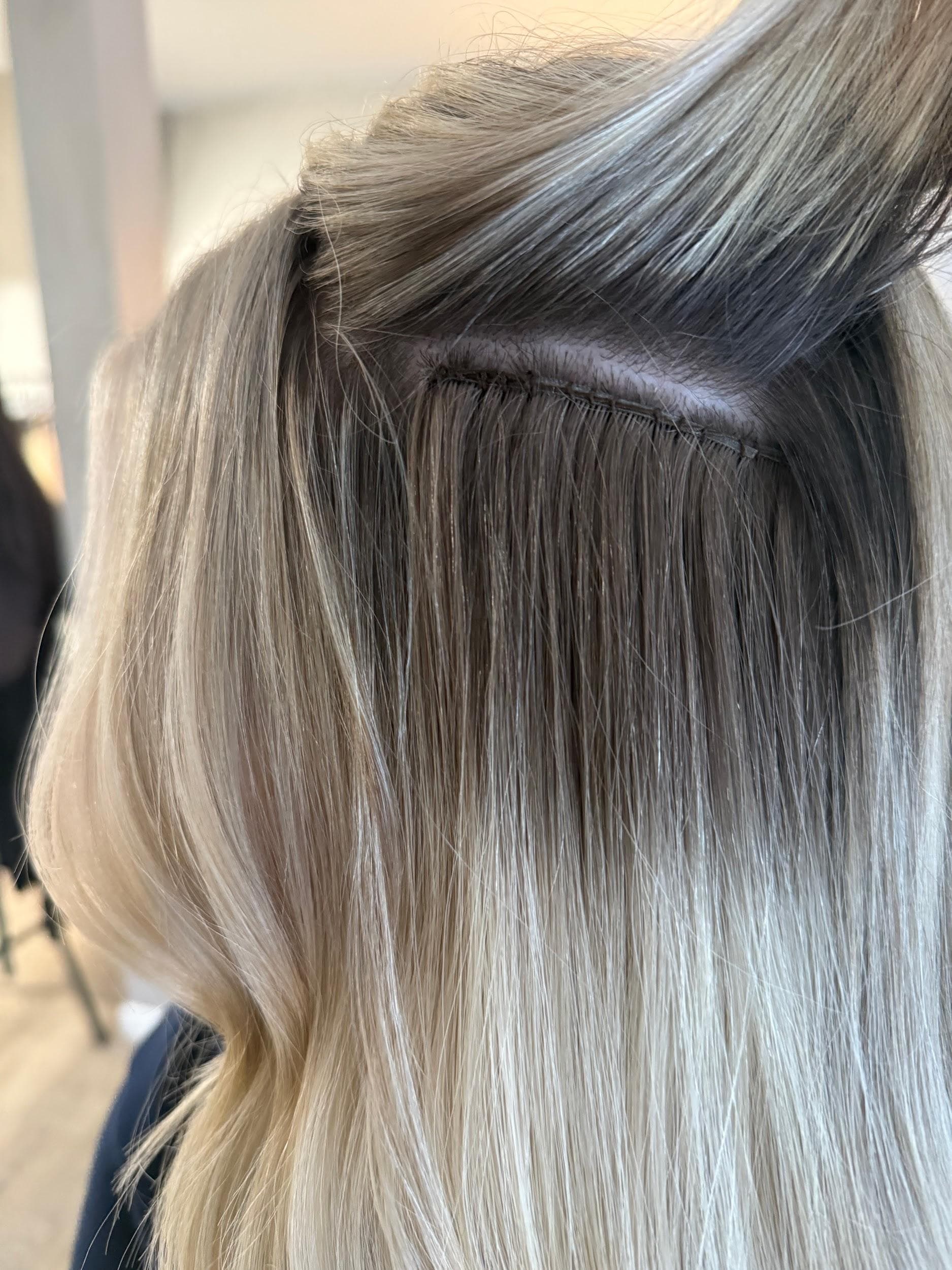
Hand-tied wefts are thin, flexible curtains of hair. Instead of being stuck to your hair, they are stitched onto a foundation row of silicone-lined beads. The method we use is Invisible Bead Extensions, or IBE for short. You will also hear the general family called hand-tied, beaded wefts, or sew-in wefts.
The weight is spread across the row rather than loaded onto a few points, and there is no tape, no glue, and no heat. As your hair grows, the row is moved back up toward the root every 8 to 10 weeks. This is the method for volume and length together.
K-tip extensions, also called fusion
K-tip is short for keratin tip. Each small bundle of hair ends in a keratin bond that is heat-fused to a strand of your own hair, which is why you will also see it called fusion or keratin bond extensions. Because every piece is placed on its own, it is the most precise of the three: density exactly where you want it, including fine areas and around the part. IBE and k-tips are very similar in what they do for you. The biggest difference is the hair itself: k-tips are made by hand from raw hair, so the quality is higher than the wefts used in IBE. An install is done in a single day, typically 4 to 6 hours, and the bonds are removed and re-set every 3 to 5 months. See keratin tip extensions in Pittsburgh for the details, or k-tip vs. Invisible Bead if you are choosing between our two.
Which one is right for you?
It comes down to your hair and what you want it to do. If you want length and fullness together and your hair is medium to thick, an IBE row is usually the answer. If your hair is fine, or you want density placed in specific spots, k-tips are often the better tool, and sometimes the answer is a lighter IBE install. There is more on that in hair extensions for fine, thin hair.
The honest way to decide is a consultation, where we can see your density, your growth pattern, and your color in person. It is free. For prices, see what hair extensions cost in Pittsburgh.
Common questions
- Do you offer tape-in extensions in Pittsburgh?
- No. We do not offer tape-ins because we care about the health of your hair. Tapes are known to pull out hair and cause damage. Lost Sheep Salon installs two methods instead: IBE (Invisible Bead Extensions), which are hand-tied wefts on a bead row, and keratin tip extensions. Neither puts tape or glue on your hair.
- Is fusion the same as k-tip extensions?
- Yes. K-tip is short for keratin tip. Each small bundle of hair has a keratin bond at the end that is fused to a strand of your own hair, which is why the method is also called fusion or keratin bond extensions.
- Are IBE (hand-tied) extensions the same as tape-ins?
- No. Tape-ins are held to your hair with adhesive tabs. With IBE, hand-tied wefts are stitched onto a row of beads, so nothing is stuck to the hair itself. They are moved up along that row as your hair grows.
- Which extensions go longest between appointments?
- Keratin tips. The bonds are removed and re-set every 3 to 5 months. IBE rows are moved up every 8 to 10 weeks.
- How much do IBE (hand-tied) and k-tip extensions cost?
- Install labor at Lost Sheep is $85 – $110 per row for Invisible Bead Extensions and $85 – $110 per hour for keratin tips. The hair itself is quoted at a free consultation.